
A War Halfway Around the World Is Costing Rio Grande Families $55 Every Month


The Persian Gulf is roughly 8,000 miles from McAllen. The Strait of Hormuz — the waterway at the center of this conflict — is a place most Valley families will never see. None of that matters when you're filling up at the pump, because this war's cost doesn't stay overseas.
How the Iran War Is Hitting Rio Grande Valley Wallets
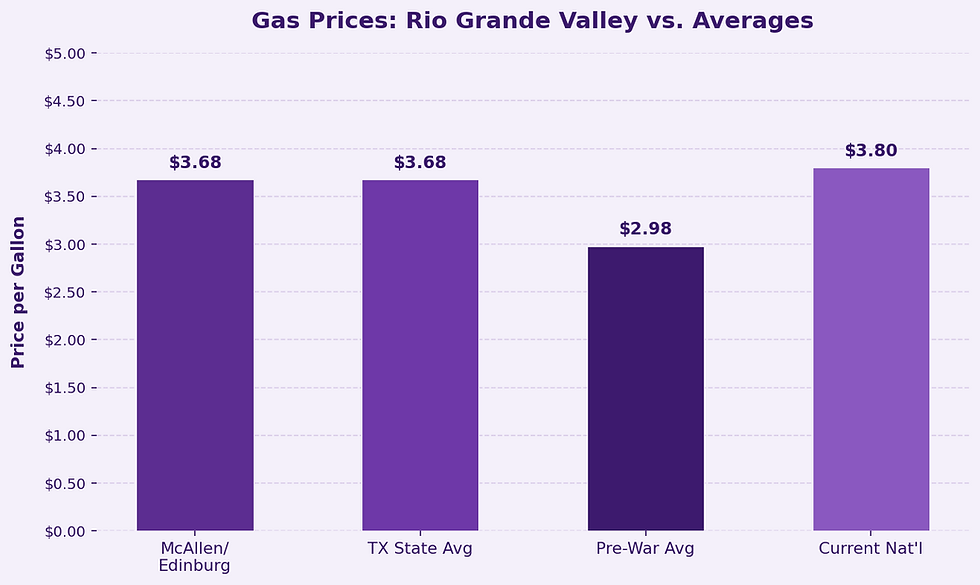
Oil is traded globally, which means a conflict anywhere near a major shipping route affects prices everywhere. The Strait of Hormuz is the narrow channel connecting the Persian Gulf to the open ocean — roughly one in five barrels of the world's oil passes through it every day. Iran sits at its edge. When the U.S.-Israel war with Iran began, navigating that passage became uncertain, and oil markets sent crude past $100/barrel almost immediately. The pre-war national average of $2.98/gallon gave way quickly.
In a region where public transit is limited and most families depend entirely on their vehicles, a 20-gallon fill-up now costs roughly $14 more than before the conflict — over $55 more every month just to get around. That's before a single bag of groceries is bought.
And Then You Head to the Grocery Store
At the H-E-B locations across McAllen — on Trenton, N. 10th, Pecan, and Expressway 83 — and at Walmart Supercenters in McAllen and Edinburg, shoppers are noticing prices that weren't there before. Ground beef is $6.90/lb, milk is running around $3.68/gallon, and eggs are $3.93/dozen. Eggs, milk, and meat have all been trending up across Valley stores. Sprouts is expanding in the area, though fresh and organic comes at a premium most families aren't in a position to pay every week.
The Rio Grande Valley has historically been one of the more affordable places to buy groceries, and local stores have worked to hold prices down. But oil's reach into the food supply chain is long — it costs more to ship food, refrigerate it, and stock the shelves when fuel is expensive. This war's price doesn't stay in the Middle East. It comes home on the receipt.
The Valley Feels the Tariff Impact Differently
Few places in the country feel tariffs on Mexican imports as directly as the Rio Grande Valley. The 25% tariff on goods from Mexico hits produce that moves right through this region — tomatoes, avocados, limes, peppers, onions, cucumbers. Much of it crosses through the Valley itself on its way to American grocery stores. When tariffs add cost at the border, that cost gets built into the price before the food even reaches the shelf at H-E-B or Walmart.
For McAllen and Edinburg families, the grocery bill is being pushed up by two separate forces at once: fuel costs from the Iran war running through the delivery chain, and tariff costs from trade policy running through the import chain. Valley stores have worked to absorb what they can, but there's only so much that can be absorbed before it shows up at checkout. The receipt is longer than it used to be, and there are now multiple reasons why.

