
Millions Living With HIV Fear What Happens When the Doctor Stops Coming to the Door

For millions of people living with HIV in rural Africa, survival has depended on something most Americans take for granted — a healthcare worker showing up. Now, sweeping cuts to U.S. foreign aid are threatening to unravel that lifeline, and the consequences are being felt one missed home visit at a time.
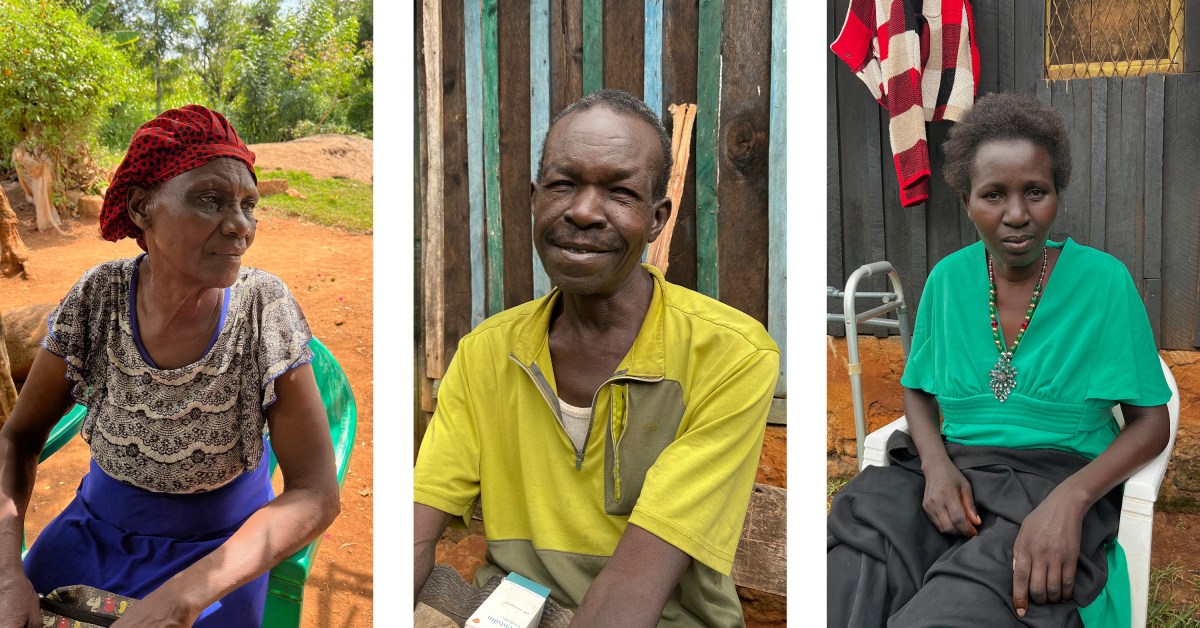
Florence Mwendwa, 49, is proof of how much a home visit can matter. She lives in a remote corner of rural Kenya, surrounded by tea farms, in a home that burned down earlier this year. Her husband, Ashford Mutwiri, is a tea farmer. Together, they cannot afford transportation to a hospital. When she was at her sickest — bedridden and unable to stand — it was a team from a nearby mission hospital that came to her. Today, she uses a walker and is visibly stronger. The difference, her caregivers say, is antiretroviral treatment, or ART, the medication that keeps HIV from progressing into a death sentence.
Her medications are funded through the President's Emergency Plan for AIDS Relief, known as PEPFAR — a U.S. government program that currently keeps 20.6 million people with HIV alive worldwide. After the Trump administration brought the program to a sudden halt last year, the drugs are flowing again. But much of everything else PEPFAR used to fund — the home visits, the community testing, the outreach workers who traveled muddy roads to find patients who had missed appointments — has been gutted under what the administration calls an "America First" global health strategy.
The new policy prioritizes paying for medications — what officials call "commodities" — while cutting back on the surrounding network of care that gets those medications to the people who need them most.
A Hospital Doing More With Half the Staff
Chogoria Hospital, a mission hospital run by the Presbyterian Church of East Africa, is where Mwendwa receives her HIV treatment. It operates one of the oldest HIV clinics in the region and serves the majority of HIV patients in its county. Over the past year, the hospital absorbed a 50 percent cut in PEPFAR funding — losing staff, programs, and the community health workers who once fanned out into rural areas to find patients who had fallen off treatment.
Before the cuts, Chogoria had 29 staff members dedicated to HIV care and 20 community health workers making regular trips into the countryside. Today, 14 staff members remain in dedicated HIV roles, with five others splitting their time across multiple responsibilities. The community health workers are gone.
"We're used to receiving a 5 percent cut, a 10 percent cut," said Rebecca Juma, who runs the HIV program at Chogoria. "But a 50 percent cut — it came so drastically. It was a big hit."
Juma still finds a way to keep going. "You have to maneuver somehow," she said.
For now, a small team of remaining staff — a physician's assistant, a nurse, and a social worker — continues making home visits to the most vulnerable patients, kept afloat by a private donor rather than U.S. government funding. But that support is not guaranteed, and it does not replace what was lost.
The Patients Behind the Numbers
Journalism outlet Christianity Today visited four rural mission hospitals across East Africa, as well as one urban HIV clinic, to document the human reality of these funding cuts one year later. What they found were patients and health workers improvising in the face of scarcity — and quietly worrying about the future.
One HIV patient biked 14 miles to make his appointment. Medical staff have taken on multiple job titles. Hospital administrators have restructured entire departments just to stay open.
Rosemary Mukwanjiru, 71, is one of the patients the Chogoria team still visits. She lives a half-mile walk across farmland from the nearest road. Her daughter was killed in a robbery. Now she raises her grandchildren with little income and cannot afford the trip to the hospital on her own. When the care team visited her in June — bringing a three-month refill of her antiretroviral medication — she pointed to the nurse and social worker on the team and called them a miracle.
"I would not be alive," Mukwanjiru said. "Sometimes just a phone call [to check in] is enough."
Joseph Naivasha, 64, another Chogoria patient, smashes rocks and sells the gravel to cover his bills after leasing out his tea plot. In addition to HIV, he was diagnosed last year with heart failure and a chronic lung condition. At his worst, neighbors had to carry him up the hill from his home just to reach the road. A hospital trip that once took two hours now takes five. When the Chogoria outreach team found him in January, he was housebound and alone. The hospital admitted him for a month. By June, he was standing outside waiting for their visit.
"I'm praying to God to grant me a long life," Naivasha said through a translator. "I want to live more."
When Patients Stop Coming In
The concern shared by doctors and hospital administrators across the region is not just about the patients they can still reach — it's about the ones they can't.
At Macha Mission Hospital in rural Zambia, outreach staff who once tracked down patients on motorbikes during the rainy season are no longer funded. The hospital serves about 2,000 HIV patients. Nurse Sydney Gutichilala, who handles HIV care there, said outreaches have stopped entirely after the loss of U.S. funding.
Gutichilala worries that patients who can't afford transportation will simply stop taking their medication. And when someone with HIV stops treatment, the virus can rebound — making the person sick again and increasing the risk of transmission to others.
Karen Sichinga, who leads the Churches Health Association of Zambia — a coalition of faith-based facilities that provides roughly 30 percent of the country's healthcare and oversees 116,000 HIV patients — has been part of recent negotiations with U.S. representatives on health funding, including a DOGE official. She acknowledged the continued supply of medications but was direct about what has been lost.
"[The United States] will still buy drugs. We're happy about that. We are very, very grateful," Sichinga said. "But any other activities that they did not consider lifesaving, they completely stopped."
Her organization is actively tracking whether patients are defaulting on treatment. So far, the numbers have not spiked dramatically — but the trend is visible.
"Even though we are beginning to see that some people are defaulting, it's not an alarming figure yet," Sichinga said. "We are watching it. But we know lack of funding is contributing."
Communities Filling the Gaps
Some of the most important work holding this system together is now being done by patients themselves.
Caroline Mburia, 46, has been receiving HIV medication at Chogoria for 19 years — her life sustained entirely by PEPFAR funding. Now she volunteers to encourage others in her community to seek treatment and is openly public about her own HIV status to fight the stigma that still keeps people from getting tested or staying on medication.
Mburia and another longtime patient, Purity Kawira, run a community support group for people with HIV in their village. The group used to receive some U.S. funding. Now they host it as unpaid volunteers.
"This hospital, they love their patients," Kawira said. "They keep calling, wanting to know your progress."
But Mburia is afraid of what comes next — for her neighbors, and for anyone who gets sick and cannot afford the journey to care.
"We pray every day that something bad will not happen," Mburia said. "We feel scared because we have seen what happened before — seeing a person dying slowly."
Doctors across the region share that fear. They describe watching decades of hard-won progress against HIV begin to quietly erode — not in a single dramatic moment, but in a hundred small ways: a missed appointment, an empty fuel tank, a health worker whose contract was not renewed.


