
Christian Supporters and Faith Leaders Speak Out After Trump Posts AI Image Resembling Jesus

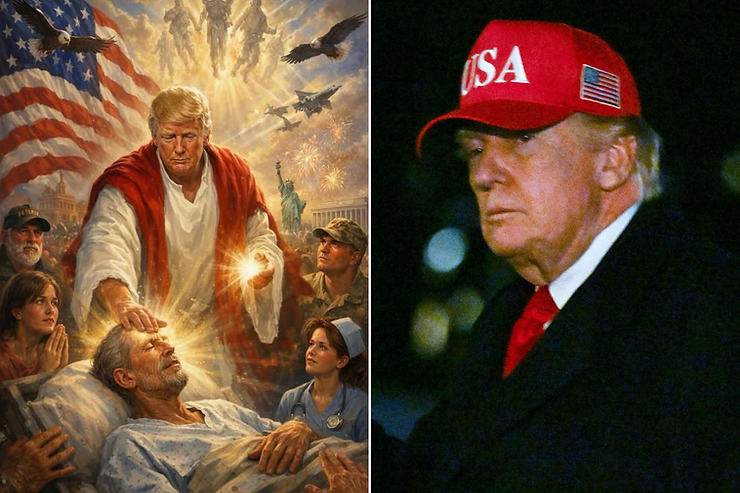
A single social media post managed to do something rare in American politics — it united Trump critics and some of his most devoted Christian supporters in shared concern. The image, which showed President Donald Trump in robes performing what many recognized as a healing gesture associated with Jesus Christ, sparked immediate backlash and was gone from his account by Monday morning.
Late Sunday night, Trump uploaded an AI-generated image to Truth Social. It showed him dressed in white and red robes, with one hand placed on the forehead of a sick person and the other hand emitting light. The visual closely resembled how Jesus is portrayed in traditional Christian artwork, and the response was fast and forceful — coming not only from political opponents, but from conservatives and faith leaders who have consistently supported the president.
What Trump Said
During an unplanned press conference Monday — held while Trump appeared to be receiving a McDonald's delivery from a DoorDash driver — reporters asked him directly about the post. Trump said he believed the image showed him acting as "a doctor" and that it "had to do with" the Red Cross. No Red Cross symbols or references to medical workers were visible anywhere in the image.
Reactions From Christian Voices
What made the backlash especially significant was how much of it came from within Trump's own support base. Several well-known conservative Christians and faith leaders made their concerns public and did not mince words.
Fox News contributor and conservative activist Riley Gaines, widely known for her advocacy on issues involving transgender athletes in sports, expressed clear frustration. She wrote, "Why? Seriously, I cannot understand why he'd post this. Is he looking for a response? Does he actually think this?" She also stated that "a little humility would serve him well" and that "God shall not be mocked."
Conservative Gen Z commentator Brilyn Hollyhand posted a video response on X, saying that "comparing yourself, even jokingly, to Jesus ... undermines the very value that many of us hold dear." His post was captioned, "This is gross blasphemy."
Michael Knowles, a conservative Catholic podcast host, urged the administration to remove the image, writing, "I assume someone has already told him, but it behooves the President both spiritually and politically to delete the picture, no matter the intent."
The Rev. Paul D. Erickson, bishop of the Greater Milwaukee Synod of the Evangelical Lutheran Church in America, placed the image in a wider context, writing to Axios that it is "another example of how the current administration is embracing Christian Nationalism." He argued that this approach "seeks to create an unholy and unhealthy alliance between political leadership and divine providence" and "confuses the kingdom of God with a particular government."
A Pattern That Is Becoming Hard to Ignore
This is not the first time an AI-generated image from Trump has drawn condemnation from Christian communities. After Pope Francis died, Trump posted a fabricated image of himself dressed in papal robes. That post was criticized by Cardinal Timothy Dolan, who is typically considered one of Trump's more supportive voices within the Catholic Church.
Sunday's Jesus-like image was posted less than an hour after Trump publicly attacked Pope Leo XIV on Truth Social, calling the leader of the global Catholic Church "WEAK on Crime, and terrible for Foreign Policy." When the pope was told about Trump's comments, Leo said he had "no fear" of the American administration.
Archbishop Paul Coakley, president of the U.S. Conference of Catholic Bishops, said he was "disheartened" by the president writing "such disparaging words about the Holy Father."
The episode points to a broader pattern of friction between the Trump administration and Christian institutions. The White House has pledged to eliminate "Anti-Christian Bias" in federal policy, but its aggressive immigration enforcement and military actions have drawn criticism from faith leaders across a wide range of denominations.
That divide has deepened over the ongoing war in Iran. In a "60 Minutes" interview that aired Sunday, three cardinals leading major U.S. archdioceses expressed support for Pope Leo XIV's calls for peace. Cardinal Robert McElroy said directly that the conflict is not a "just war" under Catholic teaching and is "a war of choice."
White Protestants and Catholics made up a significant portion of the Christian voter base that helped return Trump to the White House. Moments like Sunday's post raise genuine questions about how long that support can hold under the weight of repeated controversies touching on faith.

